
The Growth Capacity Field Manual
- Charles Baker
- 3 days ago
- 7 min read

Part 1: The Operating System
Following on from "Why Some People Keep Getting Better" and "How to Interview for Growth Capacity"
Firstly, why have I called this a 'Field Manual'? Because 'framework' sounds like something you'd discuss in a workshop, and leaders don't need yet another framework. They need something they can actually use when they're three months into a role that's nothing like what they expected, feedback is contradictory, and their CEO or the board are demanding answers they don't have yet. Field manuals are what you grab when you're in unfamiliar territory and need to know what to do next. So, this is an operational guide for leaders who need to sustain learning under complexity, scrutiny, and consequence. And shows you how to keep getting better when the traditional learning loops have stopped functioning.
Why This Manual Exists
At any Executive level, but especially at C-Suite level, growth rarely fails because of intelligence, work ethic, or ambition. Most executives at this level have already demonstrated all three repeatedly.
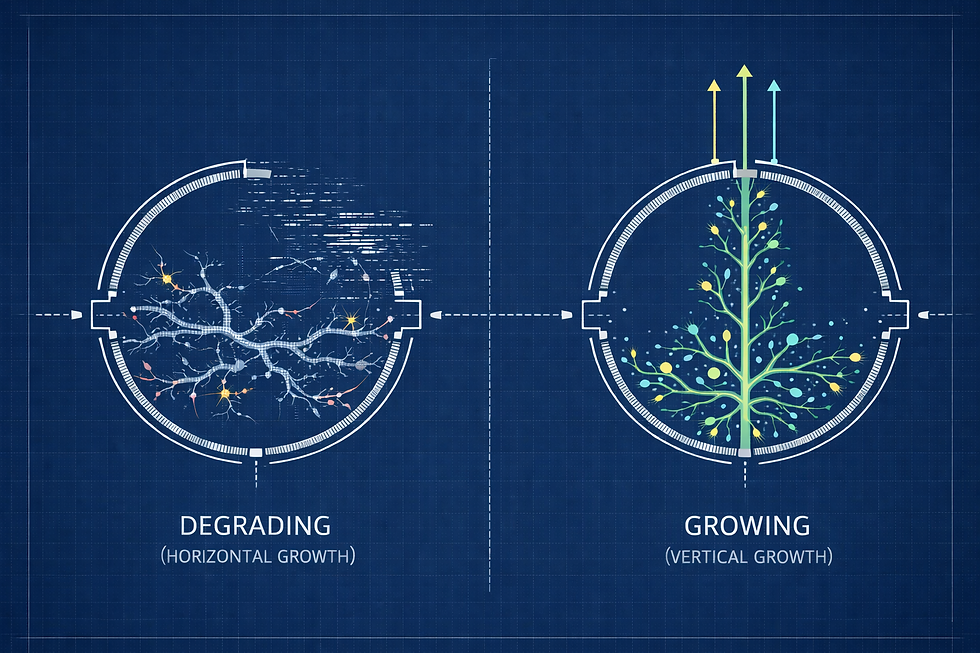
What fails is something more subtle and more structural: the learning mechanisms that worked earlier in the career quietly degrade as seniority increases.
Earlier on, learning was forced:
Decisions were closer to the work. Consequences more visible. Feedback arrived quickly and often unfiltered. Performance gaps were harder to explain away. The environment itself closed the learning loop.
At executive level, those conditions no longer hold.
Decisions move further from the ground, where signal is strongest. Outcomes lag actions by months or years, making cause and effect harder to disentangle. Feedback is filtered, softened, or delayed as it moves up the organisation. Well-intentioned colleagues manage risk by managing what you hear. And as the stakes rise, so does the cost of being visibly wrong.
At the same time, identity hardens. Past success becomes part of how the executive understands themselves: the kind of leader I am, what has always worked for me, why I'm in this seat. This is rarely conscious, but it subtly shapes what gets noticed, what gets questioned, and what gets defended.
The result is not stagnation in the obvious sense. Most executives remain busy, decisive, and outwardly effective. But learning shifts from capability expansion to pattern repetition. Experience accumulates, but judgement stops updating at the same rate. The executive keeps applying increasingly refined versions of yesterday's answers to today's problems.
What Growth Capacity Actually Means at This Level
This is why growth capacity at the executive level is not about learning more in the conventional sense. It is not about additional frameworks, books, or programs.
It is about sustaining genuine learning under conditions that actively suppress it.
Specifically:
→ Learning when feedback is ambiguous or politically filtered
→ Learning when outcomes are delayed and attribution is unclear
→ Learning when admitting uncertainty carries reputational risk
→ Learning when identity and track record are on the line
The executives who continue to grow are not immune to these forces. They simply build deliberate counterweights: structured reflection, external truth-tellers, disciplined feedback loops, and environments that reintroduce friction into their thinking.
Without those counterweights, even exceptional executives do not stop working hard or caring. They simply stop updating fast enough for the complexity they now face.
SECTION 1: DIAGNOSTIC
When to Use This Manual
Review these indicators. If three or more apply, this manual is operationally relevant:
Decisions are further from ground truth than they used to be
Feedback arrives later, softer, or more filtered
You're solving familiar problems in unfamiliar contexts
Your identity is increasingly tied to past success patterns
Team capability seems capped by your presence
External inputs come primarily from people similar to you
Field Note: None of these are failures. They're predictable by-products of seniority.
SECTION 2: WORKING DEFINITION
Growth Capacity for Senior Leaders
Operating definition:
The ability to continuously update judgement, behaviour, and influence across changing contexts by operating effective learning loops at the individual, organisational, and systemic level.
Why This Matters Now
Executive effectiveness increasingly depends on:
Recalibration speed How quickly you change course when the facts change.
Feedback metabolism Whether you can still get the truth and act on it when people stop telling you straight.
Capacity building Growing your team's capability instead of being the smartest person in the room.
System robustness Whether you can still learn when you're stressed and the stakes are high.
Failure Mode Alert: At this level, you can appear busy and decisive while learning slows dramatically.
SECTION 3: THE THREE OPERATING LEVELS
LEVEL 1: Individual Learning Under Pressure
Primary shift: Learning is no longer driven by instruction. It's driven by interpretation.
Self-Diagnostic Questions
Ask yourself honestly:
How do I know when one of my assumptions is no longer valid?
What happens internally when I am challenged, contradicted, or exposed?
How quickly do I convert outcomes into improved judgement?
What Actually Matters at This Level
✓ Learning velocity (not knowledge accumulation)
✓ Feedback metabolism (not openness in principle)
✓ Emotional regulation under ambiguity
✓ Willingness to revise identity-linked beliefs
Common Stall Point: Many executives stop growing here. Not because they stop caring, but because no one forces the learning loop to close.
LEVEL 2: Organisational Learning Architecture
Primary shift: You are no longer the primary learner in the system. You are the architect of the learning environment.
Performance Indicators
Growth capacity at this level shows up in observable patterns:
Does your team learn faster or slower because of you?
How do psychological safety and challenge coexist around you?
Are mistakes converted into shared insight or buried?
How much capability remains when you're not in the room?
Critical Recognition:
Executive growth is no longer measured by personal improvement alone, but by how much capacity you build in others.
Common Failure Mode
Capability Cap: Many skilled executives unknowingly create a learning ceiling around them. Not through incompetence, but through their leadership style.
Field Note: If your team performs significantly worse without you present, that's a data point about your growth capacity, not theirs.
LEVEL 3: Systemic Input Design
Primary shift: External learning systems become the primary calibration mechanism.
The Invisible Layer
Most executives underestimate this level. Yet it's often decisive.
High-growth executives operate external learning systems:
→ Peers who will tell them the truth
→ Advisors who are not impressed by their title
→ Exposure to adjacent domains that stretch thinking
→ Deliberate distance from echo chambers
Self-Check Questions
Who has permission to challenge my thinking?
Where am I exposed to unfamiliar problems?
How do I prevent success from narrowing my worldview?
Warning: Without this layer, even strong executives become internally coherent but externally misaligned.
SECTION 4: THE OPERATING SYSTEM
The Executive Learning Loop
Rather than linear development plans, high-performing executives operate a disciplined three-stage loop:
┌─────────────┐
│ INPUTS │ → Raw signals from reality
└──────┬──────┘
│
▼
┌─────────────┐
│ PROCESSING │ → Converting signals to insight
└──────┬──────┘
│
▼
┌─────────────┐
│ OUTPUTS │ → Changed behaviour & decisions
└──────┬──────┘
│
└────────────→ (Loop continues)
Stage 1: INPUTS
What to capture:
Feedback from credible sources (not just friendly ones)
Data from outcomes, not intentions
Exposure to unfamiliar perspectives
Moments of friction, failure, or surprise
Field Test: If you haven't been surprised by anything in the last month, your input system is degraded.
Stage 2: PROCESSING
How to process:
✓ Structured reflection (not rumination)
✓ Separation of ego from evidence
✓ Pattern recognition across contexts
✓ Honest examination of personal contribution
Common Trap: Processing becomes justification rather than examination.
Quality Check: Can you articulate what YOU did that contributed to the outcome? Not just what happened to you.
Stage 3: OUTPUTS
What changes:
→ Behavioural adjustments (observable differences)
→ Decision rule updates (new heuristics)
→ Changed leadership moves (different interventions)
→ Explicit experimentation (testing new approaches)
Critical Marker: If nothing changes in how you operate, you haven't actually processed the input.
Field Note: When this loop degrades, you still appear busy and decisive, but learning velocity drops to near zero.
SECTION 5: FAILURE MODE REFERENCE
Common Degradation Patterns at C-Suite
1. Experience Overfitting
What it looks like: Past success becomes a universal template rather than one data point.
Early warning signs:
"This worked at [previous company]" appears frequently in your reasoning
You're surprised when context-specific approaches fail
Team members stop suggesting alternatives
2. Feedback Dilution
What it looks like: Signals arrive late, softened, or reframed to protect relationships.
Early warning signs:
You only hear about problems after they've escalated
Feedback feels generic or overly diplomatic
You're learning critical information from external sources
3. Emotional Narrowing
What it looks like: Stress reduces curiosity and increases control rather than clarity.
Early warning signs:
Under pressure, you revert to command-and-control
Questions feel threatening rather than interesting
Your range of responses shrinks when stakes rise
4. Role Identity Lock-In
What it looks like: You become attached to who you have been rather than who the situation now requires.
Early warning signs:
Discomfort when asked to operate differently
Resistance to feedback that challenges your self-concept
Defining yourself by past achievements rather than current capability
Field Note: None of these are moral failures. They are predictable by-products of seniority. Recognition is the first step in system repair.
SECTION 6: OPERATIONAL CHECKLIST
Monthly System Audit
Use this checklist to verify your growth capacity operating system remains functional:
Input System Check
□ Received feedback from someone who doesn't benefit from pleasing me
□ Encountered a perspective that challenged my current thinking
□ Learned something that surprised me about my impact
□ Exposed myself to a domain outside my expertise
Processing System Check
□ Documented what I learned from a recent outcome
□ Identified my specific contribution to a failure or success
□ Revised at least one assumption I held at start of month
□ Separated my emotional response from the evidence
Output System Check
□ Changed a specific behaviour based on recent feedback
□ Updated a decision rule or heuristic I use
□ Experimented with a new leadership approach
□ Observed measurable difference in my impact
Scoring:
9-12 checks: System operating well
5-8 checks: System degrading, requires attention
Below 5: System failure, immediate intervention needed
SECTION 7: FIELD MANUAL STRUCTURE
The Complete Guide
This is Part 1 of the Executive Growth Capacity Field Manual. It establishes the operating logic and core framework.
The remaining parts go deeper into each growth dimension that differentiates executives who keep improving from those who plateau:
Part 2: Learning Velocity at Executive Scale
Part 3: Feedback Metabolism When Power Distorts Signals
Part 4: Expanding Cognitive Range Beyond Functional Expertise
Part 5: Emotional Capacity Under Sustained Ambiguity
Part 6: Building Growth Through Others, Not Around Them
Part 7: Selecting Environments That Continue to Stretch You
Part 8: Signalling Growth Capacity in Senior Transitions
Each part maintains the field manual format: practical, evidence-informed, grounded in the realities of senior leadership, with diagnostic tools and operational checklists throughout.
FINAL FIELD NOTE
At the Executive level, growth is no longer accidental. It is must be designed.
The executives who keep getting better are not necessarily smarter or more driven.
They simply operate better learning systems - even when success, pressure, and status conspire to shut those systems down.
End of Part 1: The Operating System
Part 2: Learning Velocity at Executive Scale will be published on the site later in the week


Comments